 Skip to content


verification of the Rankine yield criterion and the Tresca yield criterion
| Code | WP130 |
Description:
- Stress hypotheses are applied in the science of the strength of materials when calculating comparative stresses where unequal stresses are combined.
- The following stress hypotheses, taking into account material properties, have been tried and proven in practice: Rankine yield criterion (direct stress hypothesis), von Mises yield criterion (change of shape hypothesis) and Tresca yield criterion (shear stress hypothesis).
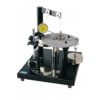
- The experimental unit WP 130is used to verify these comparative stress hypotheses on test specimens made of various metals.
- For the purpose, a multi-axial stress state is produced at a point on the specimen and the resulting deformation is measured.
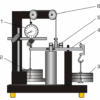
- The specimen is clamped on one end to the fixed frame.
- A loading plate is clamped to the specimen on the other end.
- A weight is attached on the outer circumference of the plate.
- A balance weight compensates for the dead-load of the plate and the applied weight.
- As a result, only direct and shearing stress occur at a point on the test specimen and shear forces are avoided.
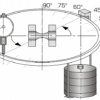
- The loading plate has a graduation grid enabling weights to be attached at 15° increments.
- This permits purely bending moment and twisting as well as combined load moments to be achieved.
- Diametrically opposite the weight, measuring points are provided on the loading plate to measure the deformation.
- This enables the deformation at the point of maximum deflection to be measured.
- The various elements of the experiment are clearly laid-out and housed securely in a storage system.
Technical Details:
Specifications:
- experiments verifying comparative stress hypotheses from the science of the strength of materials
- 7 different load combinations of bending and torsion
- loading of the test specimen without shear force by compensation for the influence of dead-load
- test specimens made of steel, copper, brass, aluminium
- generation of load moments by means of weight and lever arm
- measurement of the deformation at the point of maximum deflection
- storage system to house the components
Technical Data:
- Specimens:
- length: 49mm
- clamping length: 11,5mm
- specimen diameter in measuring cross-section: Ø 4mm
- Weights to place load on specimens:
- 1x 2N (hanger), 1x 1N, 1x 2N, 1x 4N, 2x 8N
- Weights to compensate for the load and the loading plate:
- 1x1N, 2x2N, 1x4N, 2x8N
- Lever arm: 100mm:
- Deformation:
- measuring range: 0…10mm
- graduation: 0,01mm
Dimensions & Weight:
- L x W x H: 390x330x360mm
- Weight: approx. 17kg
- L x W x H: 720x480x178mm (storage system)
- Weight: approx. 10kg (storage system)
Learning Objectives/Experiments:
- generation of multi-axial loads on test samples made of ductile metals:
- steel, copper, brass, aluminium
- generation of various load moments:
- pure bending moment
- pure twisting moment
- combined bending moment and twisting moment
- determination of the yield point
- verification of the Rankine yield criterion
- verification of the Tresca yield criterion
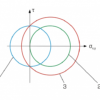
- representation in Mohr’s circle of stresses and strains
Scope of delivery:
- 1 experimental unit
- 1 set of specimens (4x St, 4x Cu, 4x Al, 4x brass)
- 1 set of weights (loading)
- 1 set of weights (compensation)
- 1 hexagon socket wrench
- 1 storage system with foam inlay
- 1 set of instructional material
Features:
- verification of the Rankine yield criterion and the Tresca yield criterion
- multi-axial loads of test specimens made of ductile metals by pure bending, pure torsion or a combination of the two
- loading of the test specimen without shear force by compensation for the influence of dead-load
Accessories:
Optional:
- WP130.01 Set of 4 bending and torsion specimens, Al, Cu, St, CuZn
- WP 130.21 Set of 4 bending and torsion specimens, Al
- WP 130.22 Set of 4 bending and torsion specimens, Cu
- WP 130.23 Set of 4 bending and torsion specimens, St
- WP 130.24 Set of 4 bending and torsion specimens, CuZn
- WP 300.09 Laboratory trolley
Due to the continuous development of our products, the goods supplied may vary in detail to that illustrated on this Website.

