 Skip to content


deflection and strain of a membrane under compressive load
| Code | FL120 |
Description:
- In experimental stress and strain analysis, strain gauges are used to determine stresses and strains in components and structures.
- The maximum stresses and strains are key variables in terms of its structure, and ultimately dictate the dimensions of a component.
- Strain gauges provide the means required to evaluate mechanical stress and strains.
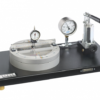
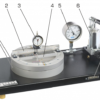
- The FL 120experimental unit can be used to measure the deflection and strain of a disk under different compressive loads.
- For this purpose, a thin disk, also called a membrane or diaphragm, is clamped into place and subjected to pressure.
- A cylinder with a hand-operated piston generates pressure in a maintenance-free hydraulic system.
- This pressure is indicated on a manometer.
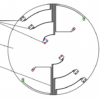
- Strains on the surface of the membrane are recorded by strain gauges.
- The layout of the strain gauges at optimally selected points provides a comprehensive view of the stresses and strains over the entire disk.
- The maximum stresses and strains are calculated by applying the law of elasticity.
- The strain gauge measurements are recorded and displayed by means of the FL 152measuring amplifier.
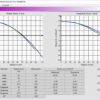
- The measured values can be imported into the application software for visualisation to evaluate the experiment.
- At the same time, the deflection of the membrane is measured by a dial gauge.
- The dial gauge can be moved along a cross-member, enabling measurements to be taken at any radius.
Technical Details:
Specification:
- investigate the deflection and strain of a thin disk under compressive load
- strain gauges measure in the radial and tangential direction
- strain gauge configured as half-bridge
- possible to measure the deflection at any radius
- measure the deflection via adjustable dial gauge, scale indicates position along the radius
- hermetically sealed hydraulic system, maintenance-free, for generating the compressive load
- hydraulic system with hydraulic pump and manometer
- FL 152 measuring amplifier required
- software for analysing measured values in FL 152
Technical Data:
- Aluminium disk:
- outer diameter: Ø 230mm
- diameter used in the experiment: Ø 200mm
- thickness: 3mm
- Strain gauge application:
- 8 strain gauges: half-bridges, 350 Ohm
- gauge factor: 2,00 ±1%
- power supply: 10V
- Dial gauge:
- 0…20mm
- graduation: 0,01mm
- Manometer:
- 0…1bar
- accuracy: class 1,0
- System pressure:
- 0,6bar
Dimensions & Weight:
- L x W x H: 700x350x350mm
- Weight: approx. 25kg
Learning Objections/Experiments:
- measure radial and tangential strain using strain gauges
- measure deflection using a dial gauge
- calculate the stresses from the measured strains: radial stress, tangential stress
- determine direction of principal stress
- application of Mohr’s strain circle to determine the principal strains
- fundamental principle: using strain gauge technology to measure strains
Scope of Delivery:
- 1 experimental unit
- 1 set of instructional material
Features:
- membrane with strain gauge application
- determine radial and tangential stress profiles from measured strains
Accessories:
Due to the continuous development of our products, the goods supplied may vary in detail to that illustrated on this Website.

