 Skip to content



For corrosion assessment
| Code | LCN700 |
| Tariff | 902480 90 |
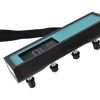
- The LCN700 Resipod is a fully integrated 4-point Wenner probe, designed to measure the electrical resistivity of concrete in a completely non-destructive test.
- It is the most accurate instrument available, extremely fast and stable and packaged in a robust, waterproof housing designed to operate in a demanding site environment.
- Complies with the proposed AASHTO standard for a surface resistivity test for estimating hardened concrete permeability.
- Surface resistivity measurement provides extremely useful information about the state of a concrete structure.
- Not only has it been proven to be directly linked to the likelihood of corrosion and the corrosion rate, recent studies have shown that there is a direct correlation between resistivity and chloride diffusion rate and even to determination of early compressive strength.
- This makes it one of the most versatile NDT methods for concrete.
Features:
- Simple to use
- Fully integrated surface resistivity instrument
- Highest resolution available for a surface resistivity instrument
- Hold, save and delete function, with onboard memory
- USB connection and dedicated PC software
- Designed to float (waterproof)
Applications:
- Surface resistivity test on standard cylinders 4″ x 8″, 100mm x 200mm or 6″ x 12″, 150mm x 300mm) with a maximum aggregate size of 1.5″, 38mm. Fixed probe spacing (1.5″, 38mm)
- Correction factor for probe spacing
- Surface resistivity mapping on site for: estimation of likelihood of corrosion, corrosion rate & implementation of cathodic protection systems
Resipod Surface Resistivity (SR) Method:
- In 2011 the American Association of State Highway and Transportation Officials (AASHTO) became the first standards body to define permeability classes based on resistivity measurements (TP95-11 Standard Method of Test for Surface Resistivity Indication of Concrete’s Ability to Resist Chloride Ion Penetration).
Since that time this test has established itself as a simple, economical alternative to the ASTM C 1202 Rapid Chloride Permeability test with several clear advantages:
- Much faster to perform
- No sample preparation necessary
- Test can be repeated at different ages e.g. 28 days, 56 days
- The same cylinder can be used for compressive strength testing
LCN700 Resipod with 1.5” (38mm) probe spacing is fully compliant with the above-mentioned standard.
Software:
- All measurements saved on the Resipod may be downloaded for analysis with the software included with all models.
- User defined correction parameters may also be defined in the software and uploaded to Resipod.
Specification:
| Resolution (nominal current 200µA) | ±0.2 kΩcm or ±1% (whichever is greater) |
| Resolution (nominal current 50µA) | ±0.3 kΩcm or ±2% (whichever is greater) |
| Resolution (nominal current <50µA) | ±2 kΩcm or ±5% (whichever is greater) |
| Frequency | 40 Hz |
| Memory | Non-volatile, ca. 500 measured values |
| Power Supply | >50 hours autonomy |
| Charger connection | USB type B, (5V, 100mA) |
| Dimensions | 197 x 53 x 69.7 mm (7.8 x 2.1 x 2.7 inch) |
| Weight | 318 g (11.2 oz) |
| Operating temperature | 0° to 50°C (32° to 122°F) |
| Storage temperature | -10° to 70°C (14° to 158°F) |
LCN700 supplied as:
- Resipod, 50mm probe spacing, test strip, foam contact pads, charger with USB cable,software, carrying strap, documentation and case.
Standard warranty:
- Electronic portion of the instrument: 24 months
- Mechanical portion of the instrument: 6 months
Due to the continuous development of our products, the goods supplied may vary in detail to that illustrated on this Website.

