 Skip to content


demonstration of basic fundamentals of mechanical vibration theory
| Code | TM155 |
Description:
- Forced vibrations occur in a variety of ways in engineering.
- While they are desirable in vibrating screens or vibrating conveyors, they are often unwanted in engines or other rotating machines.
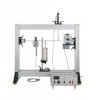
- The TM 155experimental unit clearly demonstrates the fundamentals needed to deal with free and forced vibrations.
- The differences between the two main types of excitations for forced vibrations can be shown on a simple vibration model.
- The central element of the experimental unit is a sturdy aluminium profile frame to which the different experimental setups are attached.
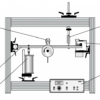
- A bar-type oscillator is used as the vibration system. This offers easy and flexible configuration.
- The spring, damper and vibration exciter can be mounted in any position.
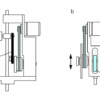
- An imbalance exciter and a displacement exciter are available for spring base-point excitation.
- The excitation frequency is set and displayed on a control unit.
- An oil hydraulic damper allows damped vibrations with adjustable damping level.
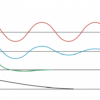
- A mechanical drum recorder offers the option of recording the vibrations.
- The measured values can be displayed and analysed on a PC using the optional TM 155.20unit for data acquisition.
- A demonstration unit for torsional vibrations (TM 150.02) is available as an accessory.
Technical Details:
Specification:
- fundamentals of mechanical vibration theory; free, damped and forced vibrations
- bar-type oscillator
- 3 coil springs
- imbalance exciter with DC motor
- displacement exciter with DC motor
- electronic control unit with digital display, adjustable excitation frequency
- damper with oil fill
- electrically driven drum recorder
- amplitude meter with electrical contact for triggering devices
- storage system for parts
Technical Data:
- Bar-type oscillator: L x W x H: 700x25x12mm, 1,6kg
- Coil springs:
- 0,75N/mm
- 1,5N/mm
- 3,0N/mm
- Exciter frequency: 0…50Hz, electronically controlled
- Imbalance of the imbalance exciter: 0…1000mmg Stroke of the displacement exciter: 20mm
- Damper constant: 5…15Ns/m, oil-filled
- Mechanical drum recorder:
- feed: 20mm/s
- paper width: 100mm
- 230V, 50Hz, 1 phase
- 230V, 60Hz, 1 phase; 120V, 60Hz, 1 phase
- UL/CSA optional
Dimensions & Weight:
- L x W x H: 1000x420x900mm
- Frame opening W x H: 870x650mm
- Weight: approx. 52kg
- Storage system:
- L x W x H: 1170x480x237mm
- Weight: approx. 12kg
Learning Objections/Experiments:
- free vibrations
- damped vibrations
- inertia force and displacement excitation
- forced vibrations
- resonance
- amplitude response and phase response
Scope of Delivery:
- 1 experimental unit
- 1 bar-type oscillator
- 3 coil springs
- 1 imbalance exciter
- 1 displacement exciter
- 1 control unit for imbalance exciter
- 1 damper
- 1 amplitude meter
- 1 drum recorder
- 1 storage system with foam inlay
- 1 set of instructional material
Features:
- demonstration of basic fundamentals of mechanical vibration theory
- damping and resonance in forced vibrations
- two different principles of vibrational excitation
Accessories:
- Optional:
– TM 155.20 System for data acquisition
– TM 150.02 Free and damped torsional vibrations
Due to the continuous development of our products, the goods supplied may vary in detail to that illustrated on this Website.

