 Skip to content


measurement of imbalance vibrations
| Code | TP502 |
Description:
- In rotating machines such as turbines or pumps, vibrations due to imbalance lead to comfort problems or even damage related to overloading.
- The imbalance of a rotating machine part may cause harmful vibrations in the entire machine. A familiar example is unbalanced tyres on a car.
- These cause annoying and unpleasant vibrations in the steering.
- This is why almost all rotating parts are balanced.
- If this balancing is done not on a particular machine but directly on the machine in operation located on-site, it is known as field balancing.
- Field balancing is done in four steps. In the first step, the vibrations are used to measure the initial imbalance.
- In the second step, additional known test imbalances are applied and the system is measured again.
- In the third step, the balancing is calculated from these two measurements and is applied.
- The fourth step is a control run to check whether the balancing has been successful.
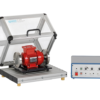
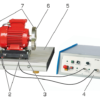
- The core of the PT 502unit comprises two flywheels that are driven by an electric motor.
- Defined imbalances can be attached to the flywheels.
- At the foot of the motor are two acceleration sensors that measure the imbalance vibrations.
- The speed is measured by an optical sensor.
- The motor is mounted on the base plate with vibration-damping rubber elements.
- The unit is driven at variable speed by a frequency converter.
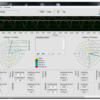
- The measured values are transmitted directly to a PC via USB, where they can be analysed using the vibration analysis software that comes included.
- This analysis software has the following features: dual-channel oscilloscope for investigations in the time range, dual-channel spectrum analyser for investigations in the frequency range, vibration amplifier and balancing module for single and two-plane balancing.
Technical Details:
Specification:
- field balancing in one or two planes
- 2 flywheels with mounting holes for imbalance or balance masses and angular division
- imbalance or balance masses in different sizes
- drive motor with variable speed via a frequency converter
- elastic bearing of the drive motor
- vibration isolation of the base plate using rubber feet
- control unit with integrated measuring amplifier
- instrumentation: optical speed sensor, 2 acceleration sensors for vibration measurement
- software functions: dual-channel oscilloscope, dual-channel FFT analyser, ramp-up curve, order analysis and balancing
- GUNT software for data acquisition via USB under Windows 8.1, 10
Technical Data:
- Flywheels:
- 2x mass: 1,675kg
- radius for balance masses: 60mm
- angular division: 15°
- Drive motor:
- speed: 300…3000min-1
- power: 370W
- Imbalance or balance masses:
- 2…10g
- total imbalance: 2x 42cmg
- Acceleration sensors
- frequency range: 1…10000Hz
- sensitivity: 100mV/g
- resonant frequency: 32kHz
- Optical speed sensor
- scan range: 3…150mm
- laser class II: 675nm
- 230V, 50Hz, 1 phase
- 230V, 60Hz, 1 phase; 120V, 60Hz, 1 phase
- UL/CSA optional
Dimensions & Weight:
- L x W x H: 510x450x380mm (experimental unit)
- L x W x H: 370x360x160mm (control unit)
- Weight: approx. 39kg (total)
Required for Operation:
- PC with Windows
Learning Objectives/Experiments:
- measure and assess machine vibrations
- occurrence of imbalance vibrations
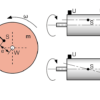
- static, dynamic or general imbalance
- dependence of imbalance vibration on position and magnitude of the imbalance
- basic principles of balancing
- field balancing in one plane
- field balancing in two planes
- assessment of balancing quality
- using a computerised vibration analyser
Scope of Delivery:
- 1 experimental unit
- 1 control unit
- 1 set of accessories
- 1 GUNTsoftware + USB cable
- 1 set of instructional material
Features:
- single and two-plane balancing
Accessories:
- Optional:
- WP 300.09 Laboratory trolley
Due to the continuous development of our products, the goods supplied may vary in detail to that illustrated on this Website.

