 Skip to content





Elasto-hydrodynamic behaviour between the sphere and rotating-glass-plate friction pair
| Code | TM260.02 |
Description:
- Elasto-hydrodynamic lubrication occurs in roller bearings, gear wheels and cam followers, whose contact surfaces are subjected to high loads.
- These surfaces are elastically deformed because of high contact pressures.
- The theory of elasto-hydrodynamics (EHDtheory) takes into consideration the elastic deformation of the bodies in contact with each other and provides a basis for calculating the influence of lubrication on damage to gears and roller bearings.
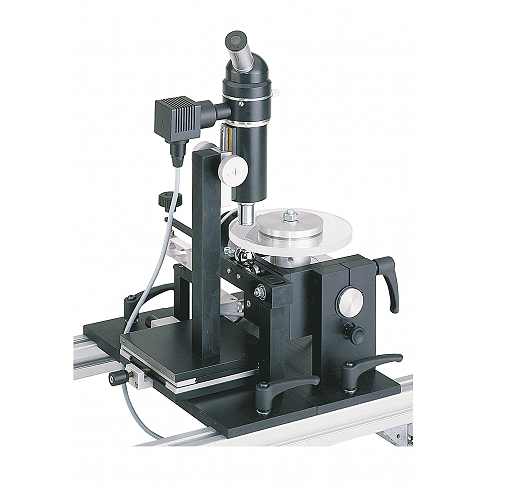
- The tribological system in TM 260.02allows a clear representation of the elasto-hydrodynamic behaviour of lubricating film layers.
- To do this, the lubricating film between a sphere and a glass plate is determined and studied using a reflected-light microscope.
- The experimental unit contains a rotating glass plate and a steel sphere as the friction pair.
- The steel sphere is pressed against the glass plate from underneath.
- The contact force between the friction partners can be adjusted continuously by means of a lever.
- A lubricating film is located between the sphere and glass plate at the contact point.
- The glass plate is plane-parallel and dielectric coated.
- The surface of the hardened steel ball is polished.
- The reflected-light microscope stands on an adjustable xy cross table and has a focus drive.
- The TM 260drive unit is required in order to conduct experiments.
- The experimental unit is mounted quickly and easily on the frame of the drive unit with quick-action chucks.
- The glass plate is driven by a clampable coupling between drive unit and gear unit.
- The display and control unit of the drive unit shows contact force and speed and allows the continuous adjustment of the speed.
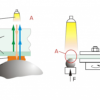
- In the experiment, light waves from the reflected-light microscope pass through the glass plate and the lubricating film and are reflected by the surface of the steel sphere.
- The light waves are refracted in the lubricating film, making colour interference fringes visible.
- The wavelength of light increases or decreases with the variable thickness of the lubricating film.
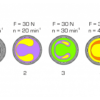
- The thickness of the lubricating film is determined visually by means of the colour of the interference fringes created.
- The contact force is measured by a force sensor.
Technical Details:
Specifications:
- elasto-hydrodynamic behaviour of a lubricating film layer between sphere and rotating glass plate
- quick and easy assembly of the experimental unit on the frame of the drive unit
- determine the thickness of the lubricating film by optical interference
- glass plate is driven by a clampable coupling between drive unit and gear unit
- hardened steel sphere, polished
- rotating plane-parallel glass plate with dielectric coating
- continuous load on the sphere via lever arm
- load measured by force sensor
- displays of force and speed and speed adjustment on the drive unit
Technical Data:
- Load application device:
- load: 150N
- lever arm ratio: 3:1
- Sphere:
- diameter: 25,4mm
- hardened steel, polished
- Glass plate:
- diameter: 150mm, plane-parallel
- coating: BK 7, dielectric, R=30%
- Microscope:
- magnification: x50
- halogen lamp: 10W
- Force sensor: 0…50N
Dimensions & Weight:
- L x W x H: 350x250x550mm
- Weight: approx. 8kg
Learning Objectives/Experiments:
- together with the drive unit:
- determine the thickness of the lubricating film at the contact point of a sphere with a plane surface – compare with theoretical value
- study the effect of load and speed on the thickness of the lubricating film
Scope of Delivery:
- 1 experimental unit
- 1 sphere
- 1 glass plate
- 1 set of instructional material
Features:
- investigation of the thickness and shape of the lubricating film
Accessories:
- Required:
- TM 260Drive unit for tribological investigation
Due to the continuous development of our products, the goods supplied may vary in detail to that illustrated on this Website.

