 Skip to content


investigation of the natural modes of various shafts with continuous mass distribution and of a Laval rotor
| Code | TM625 |
Description:
- The terms “critical speed” and “resonance” are often used when referring to rotating systems.
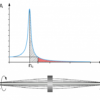
- Resonance occurs when the natural frequency and the excitation frequency match.
- The natural frequency of an oscillatory system is that frequency at which the system oscillates with the associated natural mode after a single excitation.
- Operation at critical speed can damage the system because of the high vibration amplitudes.
- In order to study the phenomenon of shaft vibration in more detail, there are two simplified calculation models.
- In the first case, the mass of the elastic shaft is evenly distributed along its length.
- In the second case, the shaft consists of massless, elastic shaft sections and the masses are combined into discrete mass disks.
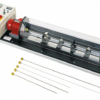
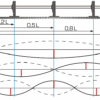
- The TM 625experimental unit can be used to study the natural modes of these different models.
- Illustrative experiments are used to explain resonance and the supercritical or subcritical states of a vibrating system.
- Six shafts of different lengths and diameters are available.
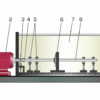
- The shafts can be mounted on four self-aligning ball bearings and fitted with a mass disk to construct a Laval rotor.
- The axial positions are read on a scale mounted parallel to the shaft.
- A three-phase motor drives the shaft via a flexible coupling.
- The electronically controlled speed can be selected via two potentiometers and is continuously variable.
- It is displayed digitally.
- A transparent protective cover and safety bearing ensure safe operation.
- The measured values can be displayed and analysed on a PC using the optional TM 620.20unit for data acquisition.
Technical Details:
Specification:
- experimental unit for determining critical speeds and investigating the natural modes of a shaft
- 6 high-tensile steel shafts
- up to 4 self-aligning ball bearings, each moveable to any point as a shaft bearing
- 1 mass for constructing a Laval rotor
- 3 safety bearings and transparent protective cover for safe operation
- three-phase motor: 2 pre-selectable speed ranges; speed electronically controlled and continuously adjustable
- digital speed display
- system TM 620.20 for data acquisition available as an option
Technical Data:
- 6 shafts
- Ø 3mm, 6mm, 7mm
- L: 600mm, 900mm
- high-tensile steel
- Mass, disk-shaped
- Ø 80mm
- m: 965g
- high-tensile steel
- Motor
- power: 0,25kW
- speed: 6000min-1
- speed electronically controlled
- Shaft bearing
- 4x self-aligning ball bearings
- 3x safety bearings
- Measuring ranges
- speed: 0…6000min-1
- scale for clearance measurement: 0…1000mm
- 230V, 50Hz, 1 phase
- 230V, 60Hz, 1 phase; 120V, 60Hz, 1 phase
- UL/CSA optional
Dimensions & Weight:
- L x W x H: 1550x380x450mm
- Weight: approx. 65kg
Learning Objectives/Experiments:
- investigation of a Laval rotor:
- critical speed
- self-alignment
- natural modes on a shaft with continuous mass distribution with:
- different bearing clearances
- different shaft diameters
- different shaft lengths
Scope of Delivery:
- 1 experimental unit
- 6 shafts
- 1 set of tools
- 1 set of instructional material
Features:
- optimal visibility and simultaneous protection thanks to transparent protective cover
Accessories:
Due to the continuous development of our products, the goods supplied may vary in detail to that illustrated on this Website.

