 Skip to content



fundamentals of mechanical friction
| Code | TM210 |
Description:
- Friction is a key factor in mechanical engineering.
- Static friction needs to be adequate to fix components to each other, such as parking brakes, self-locking threads and frictionally engaged connections.
- Dynamic friction needs to be kept as low as possible, such as on bearings, in guideways or in shaping tools.
- Consequently, great attention is paid to the topic in engineering mechanics, and understanding of it is enhanced by clearly laid-out experiments.
- TM 210provides a broad range of experiments relating to static and dynamic friction between solid bodies which are in contact with each other and moving relative to each other.
- Various influences on friction can be investigated, such as surface properties and material pairing.
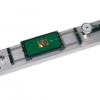
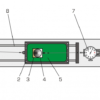
- A friction plate slides beneath the stationary friction body.
- The friction plate is held in a carriage which is drawn along by a motor at uniform velocity by a motor.
- The friction body is connected to a height-adjustable force measuring unit.
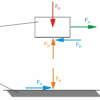
- This ensures that the lines of action of friction force and tensile force are parallel.
- The force measuring unit is essentially a force gauge which is fitted with an air damper to compensate as far as possible for slip/stick effects and so indicate a mean friction force (with no spiking).
- Three friction plates and two friction bodies are available.
- The normal force can be varied by adding weights.
- Experiments can be performed at two constant velocities.
- The air damping is adjustable.
- When it is inactive, slip/stick effects can also be observed.
- All parts are clearly laid out and well protected on a storage system.
Technical Details:
Specification:
- mechanical friction between 2 solid bodies
- friction body stationary, friction plate in a moving carriage
- 2 friction bodies each with 2 different surfaces
- 3 friction plates with a total of 4 different surfaces
- carriage driven by cable pulley and motor
- 2 driving velocities via a graduated cable drum
- force measuring unit: force gauge and adjustable air damper
- force measuring unit height-adjustable
- lines of action of friction force and tensile force always parallel
- adjustable air damper – with damping: measurement of a mean friction force adjusted by disturbances, without damping: slip/stick effects measurable
- storage system to house all parts
Technical Data:
Friction plate:
- L x W x H: approx. 175x80x6mm
- aluminium
- PVC / felt
- glass
Friction body:
- L x W: approx. 50x40mm
- dead-weight force: approx. 1N
- smooth / rough (Al), h=20mm
- brass / felt, h=5mm
Drive:
- synchronous motor
- speed: 100min-1
- driving velocities: 23,5cm/min, 47cm/min
- Weights: 8x 0,5N
Measuring ranges:
- force: 0…2N, graduation: 0,05N
- 230V, 50Hz, 1 phase
- 230V, 60Hz, 1 phase; 120V, 60Hz, 1 phase
- UL/CSA optional
Dimensions & Weight:
- L x W x H: 720x480x178mm (storage system)
- Weight: approx. 10kg (storage system)
- Weight: approx. 7kg (experimental unit)
Learning Objectives/Experiments:
- difference between static and dynamic friction
- friction forces as a function of
- normal force
- sliding velocity (relative velocities of the friction partners)
- material pairing
- surface properties of the friction partners
- size of contact area
- slip/stick effect
- determination of friction coefficients
Scope of Delivery:
- 1 experimental unit
- 1 set of weights
- 2 friction bodies
- 3 friction plates
- 1 storage system with foam inlay
- 1 set of instructional material
Features:
- fundamentals of mechanical friction
- stationary friction body, uniformly moving friction plate
- force gauge with air damping cylinder
Accessories:
· Optional: WP 300.09 Laboratory trolley
Due to the continuous development of our products, the goods supplied may vary in detail to that illustrated on this Website.

