 Skip to content


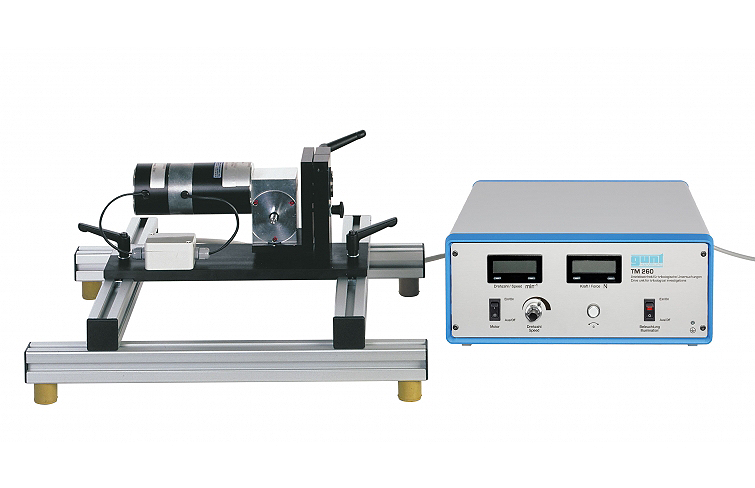


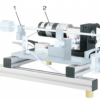
base module for studying various cases of sliding and rolling friction
| Code | TM260 |
Description:
- Tribology studies friction, wear and lubrication.
- Friction occurs when two solids are in contact with each other and their movement is impeded.
- If material is lost progressively during this process, it is referred to as wear.
- Lubricants are used to minimise friction and wear.
- The TM 260drive unit, together with the experimental units TM 260.01 to TM 260.06, offer a complete course with a series of experiments to study tribological phenomena.
- Various rolling and sliding cases can be demonstrated in the classroom or studied in the laboratory.
- The parameters of a tribological system are recorded and analysed.
- A comprehensive range of friction pairings makes it possible, among other things, to represent how the frictional force is independent of the contact area.
- The TM 260units comprise a frame on which the drive unit is mounted together with an experimental unit and a display and control unit.
- Quick-action chucks make it quick and easy to assemble.
- The drive unit has a pivotable motor block bearing.
- This allows the drive shaft to be installed horizontally or vertically.
- The speed of the DC motor is continuously adjustable and is detected by means of an incremental encoder.
- The frictional forces are measured by a force sensor in each experimental unit.
- The display and control unit shows frictional force and speed, the latter of which can be adjusted continuously.
- The following experiments can be conducted: Rolling friction in friction wheels (TM 260.01), Elasto-hydrodynamic behaviour (TM 260.02), Dynamic friction in a pin on a disk (TM 260.03), Frictional vibrations (TM 260.04), Dynamic friction in a cylindrical pin on a roller (TM 260.05), Pressure distribution in journal bearings (TM 260.06).
Technical Details:
Specifications:
- base module with drive unit and display and control unit for studying tribological phenomena
- horizontal or vertical position of the drive shaft by means of pivotable motor block
- various experimental units available as accessories
- drive unit and experimental units secured by quick-action chucks
- drive unit comprising DC motor with worm gear
- speed of the DC motor is continuously adjustable
- speed measured by incremental encoder
- frictional force measured by force sensor
- force and speed displayed on display and control unit
Technical Data:
- DC motor:
- rated speed: 3000min-1
- torque: 18,5Nm
- Worm gear: ratio 15:1:
- operating speed: 0…200min-1, electronically controlled
- Measuring ranges:
- force: 0…50N
- speed: 0…200min-1
- 230V, 50Hz, 1 phase
- 230V, 60Hz, 1 phase; 120V, 60Hz, 1 phase
- UL/CSA optional
Dimensions & Weight:
- L x W x H: 500x450x280mm (base module)
- Weight: approx. 10kg
- L x W x H: 360x330x170mm (display and control unit)
- Weight: approx. 6kg
Learning Objectives/Experiments:
- together with the experimental units TM 260.01 to TM 260.06
- rolling friction of two disks with slip
- elasto-hydrodynamic behaviour (EHDtheory) in rolling friction of a sphere against a flat surface
- wear test: pin against disk
- wear test: friction wheel experiment
- frictional vibrations and slip–stick phenomenon
- pressure distribution in the journal bearing
Scope of Delivery:
- 1 base module
- 1 display and control unit
- 1 set of cables
- 1 set of instructional material
Features:
- base module for studying various cases of sliding and rolling friction
- contact force by means of weights and lever
- electronic measurement of the frictional force between friction partners
Accessories:
- Optional:
- TM 260.01Rolling friction in friction wheels
- TM 260.02Elasto-hydrodynamic behaviour
- TM 260.03Dynamic friction in pin – disk
- TM 260.04Frictional vibrations
- TM 260.05Dynamic friction in cylindrical pin – roller
- TM 260.06Pressure distribution in journal bearings
- WP 300.09Laboratory trolley
Due to the continuous development of our products, the goods supplied may vary in detail to that illustrated on this Website.

