 Skip to content


typical phenomena of creep processes
| Code | WP600 |
Description:
- Components that are subjected to long-term constant loads deform plastically.
- This material behaviour is called creep.
- The creep rupture test is a destructive test method for determining the material behaviour (creep) at constant test temperature (room temperature and below) and after prolonged exposure to a constant load.
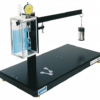
- The WP 600experimental unit demonstrates typical phenomena such as phases of different creep rates or temperature-dependent creep behaviour.
- The clean layout and simple operation mean the experimental sequence can be observed in all details and phases.
- Lead and plastic specimens are used in order to achieve acceptable creep rates at room temperature.
- Experiments can also be conducted below room temperature by means of a transparent temperature-controlled box with storage elements.
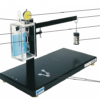
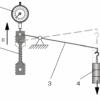
- In the experiment, the specimen is subjected to a constant tensile load at a given, constant temperature.
- The tensile load is generated by a lever and stepped weights.
- The specimen holders are equipped with knife-edge bearings to avoid bending stresses on the specimen.
- An adjustable stop protects the dial gauge at fracture of the specimen and prevents the loads impacting the experimental unit.
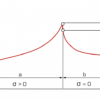
- The elongation of the specimen over time is recorded by a dial gauge and a stopwatch and represented in a strain–time diagram as the so-called creep curve.
Technical Details:
Specifications:
- investigation of creep behaviour of different materials in creep rupture test
- constant load on the specimen via lever arm and stepped weights
- flat lead and plastic (PE) specimens
- experiments at or below room temperature are possible
- transparent temperature-controlled box with storage elements for cooling the specimen
- dial gauge for determining the elongation
- stopwatch to record time
Technical Data:
- Specimens:
- L x W: 25x5mm, thickness 2mm
- 10x lead
- 10x plastic (PE)
- Weights:
- 1x 1N (hanger)
- 2x 5N
- 3x 2N
- 3x 1N
- 2x 0,5N
- Measuring ranges:
- tension: 5…25N/mm2
- travel: 0…10mm, graduation: 0,01mm
- temperature: -50…300°C
Dimensions & Weight:
- L x W x H: 700x350x510mm
- Weight: approx. 23kg
Learning Objectives/Experiments:
- creep in specimens of various materials
- record a strain–time diagram (creep curve)
- influence of temperature and load on the creep
- load and recovery in plastics
Scope of Delivery:
- 1 experimental unit
- 1 set of specimens (20 pieces)
- 1 set of weights
- 1 stopwatch
- 1 temperature-controlled box with 2 storage elements and 1 thermometer
- 1 set of instructional material
Features:
- experiments at or below room temperature are possible
Accessories:
- Optional:
- WP 600.01Set of 10 specimens, PE
- WP 600.02Set of 10 specimens, Pb
- WP 300.09Laboratory trolley
Due to the continuous development of our products, the goods supplied may vary in detail to that illustrated on this Website.

