 Skip to content


friction of different belt types on a metal pulley
| Code | TM220 |
Description:
- The belt drives are machine elements that are classed as traction mechanisms in the field of transmission or conversion elements.
- They transfer torque and speed between guiding members such as wheels or pulleys.
- The motion is transferred by traction mechanisms that can only absorb tensile forces.
- Toothed belts and chains deliver positive transmission of movements.
- Traction mechanisms such as cables, flat belts and V-belts, on the contrary, allow for non-positive transmission.
- In non-positive belt drives, the circumferential force between the belt and the pulley is transmitted according to the principle of cable friction.
- Cable friction arises due to tangential static-friction forces at the points where the cable is in contact with the wheel or the pulley.
- Eytelwein’s cable friction formula is used to calculate both cable and belt friction.
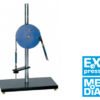
- The TM 220experimental unit allows the study by experiment of belt drives and belt friction.
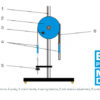
- At the core of the experimental unit is a cast iron pulley, whose circumference features grooves for V-belts and flat belts.
- The pulley is mounted on ball bearings and is powered by a crank handle.
- Its flywheel mass favours an even rotation of the pulley.
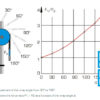
- The belts rub on the pulley at a wrap angle between 30° and 180°.
- The wrap angle can be adjusted in increments of 15°.
- Two spring balances detect the tensile forces on the respective belt ends.
- This makes it possible to precisely adjust the belt tension using a threaded spindle.
- Two flat belts made of different materials, a V-belt and a cable belong to the scope of delivery.
- The experiments compare different belt types and materials and investigate the effect of the wrap angle.
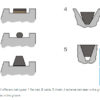
- In addition, for V-belts, it is possible to study how the groove shape affects the coefficient of friction.
Technical Details:
Specification:
- function of a belt drive
- belt friction and comparison of different belt materials and types
- ball-bearing mounted pulley with 3 different belt grooves
- 2 flat belts made of different materials, 1 V-belt and 1 cable
- wrap angle of the belts 30°…180°, graduation 15°
- force measurement with 2 spring balances
Technical Data:
Flat belts:
- 1x leather/polyamide, 15×2,2mm, Extremultus LT10
- 1x polyamide, 15×0,6mm, Extremultus TT2
V-belt:
- ISO 4184
- profile: SPZ
- 9,7×8,0mm, rubber/fabric
Cable:
- hemp, Ø=3mm
Pulley:
- Ø=300mm
- material: grey iron
- Dynamometer: 100N ±1N
Dimensions & Weight:
- L x W x H: 700x350x1100mm
- Weight: approx. 47kg
Learning Objectives/Experiments:
- effect of wrap angle, coefficient of friction and cable force (Eytelwein’s belt friction formula).
- comparison of flat belts and V-belts.
- consequences of an unadopted V-belt groove.
Scope of Delivery:
- 1 experimental unit
- 2 flat belts
- 1 cable
- 1 V-belt
- 2 dynamometers
- 1 set of instructional material
Features:
- function of a belt drive
Accessories:
· Optional: WP 300.09 Laboratory trolley
Due to the continuous development of our products, the goods supplied may vary in detail to that illustrated on this Website.

